
Voices of Lyd: Exploring Lyd Through Film and Experiential Learning

I was first introduced to the city of Lyd in the summer of 2023, as part of the Religion, Conflict and Peace Initiative (RCPI). Our visit to Lyd, which is just a 25-km drive to the southeast of Tel Aviv, was part of a two-week experiential learning period in Israel/Palestine. The trip concluded RCPI’s flagship course, ‘Learning in Context: Narratives of Displacement and Belonging in Palestine/Israel,’ which brings together an annual cohort of about sixteen students from across Harvard’s graduate schools to interdisciplinarily explore the history and present of the region through the stories that frame how individuals and communities make sense of their worlds.

Rami Younis leads RCPI students on a tour of Lyd in June 2022.
Alongside my cohort, I walked Lyd’s streets under the sweltering Middle Eastern summer heat, beginning to learn about her story: the city she once was and the city she has become. Guiding us on our first encounter with Lyd was Rami Younis, a Palestinian filmmaker and 2019-20 RCPI fellow at Harvard Divinity School. Rami spoke about how Lyd once “connected Palestine to the world,” as a center of commerce, transportation, and Palestinian life. He spoke with tenderness and admiration, explaining her strength and resilience, even in the face of ever-increasing violence.
Lyd, we learned, is what is commonly referred to as a “mixed-city,” one that contains both Palestinian and Jewish populations. This term, though, is one that is very violent in and of itself–deeply entrenched in racist policies where these two groups, though located next to each other, are often physically separated. This leads to Palestinian populations being stigmatized, ostracized, and, ultimately, pushed out of their homes by their Jewish Israeli ‘neighbors.’ It is a process not dissimilar to the way illegal settlements encroach onto Palestinian lands in the West Bank.
After our tour, we settled into a classroom to hear from the Palestinians who call Lyd home. It was clear that each of them loved the city deeply. It was out of love that these residents worked to dispel the media’s unfair stereotypes and dehumanization enacted by the language of “war on crime.” Ultimately, I think Fida’ Shehedeh, a city council member, said it best: “peace,” she said, “is nothing more than a side effect of justice.” Rami added that “when violence has permeated such intimate places, the work of bringing about justice has to get creative.”
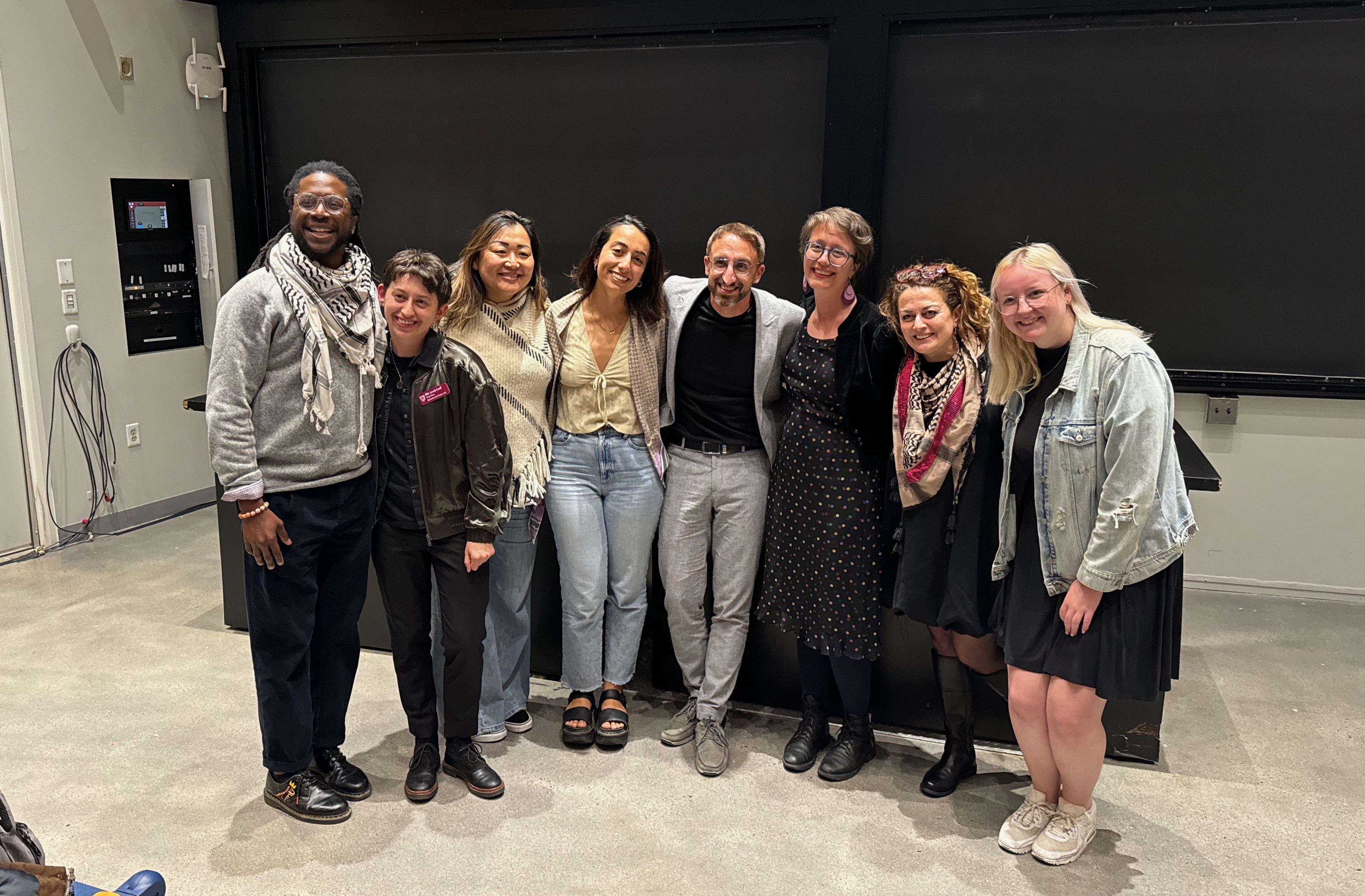
RCPI alumni gather with film directors Rami Younis and Sarah Ema Friedland.
In April 2024, back at Harvard and a world away from that Summer, many of the students who met Rami in Lyd attended the U.S. premiere of Lyd. Co-directed by Rami and Sarah Ema Friedland, Lyd tells the story of the city and its rich and often painful history. The atmosphere at the premiere was much like a family reunion; the theater was full of people who Lyd brought together. Some in the audience were Palestinians. Some were alumni of the Religion, Conflict, and Peace Initiative at Harvard eager to revisit a place we had once been. Some were even Palestinian natives of Lyd, referred to as “Lyddians.”
Through the film, Lyd is personified through first-person narration, voiced by actress Maisa Abd Elhadi. By choosing to personify the city of Lyd, the audience is able to empathize with the city through many dimensions of her “pain, love, and violence.” Over the course of the documentary, the audience meets a number of Lyddians–some who still reside in the city and some who have been in exile since the Nakba of 1948. “My children, their children are scattered,” laments the city, “I hope they return.” What these voices all have in common, however, is that no matter how far or how long they have been in exile, they still remember the beauty of Lyd’s past. In the film, memory also becomes a space of possibility. Lyd is not just another documentary about the horrors of 1948. Instead, in a sci-fi twist, not only does the film tell the history of Lyd and several of its residents, many of them not unlike those we met in the summer of 2023, but it also imagines what today’s Lyd might have looked like if the trauma of the Nakba had not occurred. When the film’s subjects go through the portal, they enter a world where Lyd is alight with celebration of Eid Lyd–by Christian, Muslim, and Jewish communities alike. It is a world of possibility, of coexistence and co-creation, and of just peace.

Left to right: Rami Younis, Atalia Omer, Hilary Rantisi, Reem Atassi, and Sarah Ema Friedland at the April film screening.
Of all of the conversations around the film, I was most struck by something that Rami said during the Q&A following the premiere at Harvard. When asked about his purpose in telling Lyd’s story, he replied, “Palestinians are constantly asked to humanize themselves. This film humanizes Lyd.” As I sat with his words, I thought back to Fida’ and the other activists we met in Lyd. The humanization of Lyd was their project too. This, ultimately, was the triumph of Lyd. It allows the city’s story to be told by the people who care about her–including Rami, Sarah, and the film’s many subjects–and provides the space to imagine an alternate future–one of peace, justice, and liberation.
In the RCPI program, we spend a lot of time thinking about the moral imagination. According to renowned peace-studies scholar John Paul Lederach, the primary role of moral imagination is to provide space for the creative act to emerge. In doing this, we are required to think deeply about how we know the world, how we are in the world, and most importantly, what in the world is possible. It is in the creation of this space of possibility that hope lives. This kind of hope, one tethered to concrete ideas about liberation and justice, is present throughout Lyd. It both allows the viewer to think about the kind of present that might be if the past had been different, and also to imagine a new kind of future.
And what is the utility of imagining in the midst of such violence and pain? Lyd tells us this, too: “if we don’t imagine, we will end up in someone else’s imagination.”
Lyd is currently screening at film festivals around the world.
By Destiny Magnett, MTS '24, RPL Graduate Assistant