
A Conversation with Terrence L. Johnson on Capital, Conscience, and Knowledge
RPL's spring conference, "Capital, Conscience, and Knowledge: Religion and the Common Good in a Market-Driven Society," delved into questions concerning the relationships between the economy, higher education, and religion.
When Terrence L. Johnson, director of Religion and Public Life (RPL) at Harvard Divinity School (HDS), set out to convene "Capital, Conscience, and Knowledge," he saw a higher education landscape under pressures unlike any in a generation. Long-running tensions over the cost and purpose of education, the disruptions of the pandemic, and a new wave of federal scrutiny had converged on universities. Endowments—once the quiet ballast of institutional life—had become flashpoints. “We’re at a moment where many different sides of the political equation are questioning endowments,” Johnson reflected. “What are they for? What say do students have in an endowment? What say does the general public have?”
Held March 26–27, 2026, the conference opened those questions through the distinctive lens of religion and moral inquiry. While the scholarly literature on religion and capitalism is substantial, Johnson noted, the literature on religion and endowments is far thinner. RPL’s task, as he saw it, was to bring the analytic resources of HDS into a conversation often dominated by economists, financial managers, and institutional leaders. “I wanted to create a conference where we can really dive into some of the deeper moral questions around how higher education both imagines and lives out a kind of moral contract,” he explained. HDS, he added, was uniquely positioned to host that exchange: “I wanted to showcase the School’s strength as an intellectual powerhouse at Harvard.”
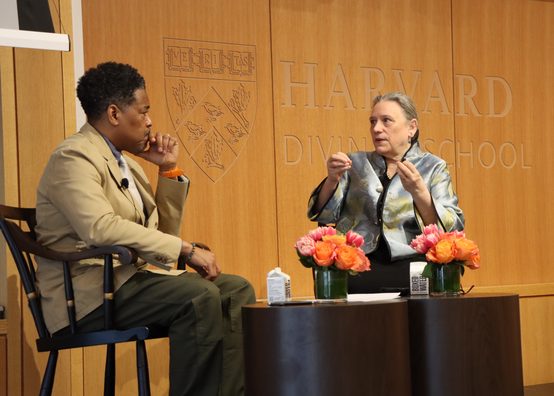
The decision to partner with Arizona State University’s (ASU) Department of Religious Studies was both intellectual and symbolic. ASU, Johnson observed, brings “a deep commitment to thinking about the public in ways that we can’t imagine because it’s a public university.” Its students “bring very different kinds of questions to bear,” and the partnership signaled that private and public institutions can—and should—work together to “expand how we think about knowledge production.”
The program itself resisted predictable pairings. Johnson composed panels that brought historians of religion and capitalism into conversation with economists and investors, and that seated religious scholars alongside provosts and asset managers. He was intentional, he said, about ensuring that every panel was moderated by a scholar of religion, “just to ensure that religion remains central, even as the conference was heavily bent toward” economic history and the technical realities of endowment management.
That structure, he argued, allowed unexpected vocabularies to surface—most notably exemplified by Laurie L. Patton, president of the American Academy of Arts and Sciences, who offered a reframing of endowments as “gifts.” Organizers, he emphasized, were not dictating new vocabularies; rather, the conditions of the conference led to a “brilliant idea around gifts.” Beneath the program lay a deeper challenge to assumptions about the university itself.
Drawing on the histories of HBCUs and the older intellectual traditions of American higher education, he argued that universities have long served as intellectually transformative sites—places where “people went with deep questions” that “often translated into very practical concerns.” Moral language, he insisted, is not the exclusive property of religious fundamentalists. "We can talk about moral claims without being religious fundamentalists," he said, urging the academy to reclaim a vocabulary of the common good without ceding it to any single tradition.
Reflecting on what emerged across the two days, Johnson identified several points of convergence. Despite their disciplinary differences, panelists shared what he described as “an agreement around this idea of the common good”—a recognition that “higher education and endowments should be focused on serving the general public,” even as the meaning of serving remained contested.
A second theme concerned accountability. He observed that endowments appear to many students and members of the public to sit “behind a veil,” opaque to the communities they are meant to sustain. The conference made plain that “we have to have more accountability, more conversations and access to what’s happening with the management of endowments.”
A third theme emerged from the keynotes delivered by Baylor University president Linda A. Livingstone and Patton: institutional leaders, despite their distinct vantage points, remain eager to listen. “Leadership still wants to hear from students," Johnson said. "We’ve got to find ways to encourage this relationship with students so that we’re all better informed.”

The risks of not convening this conversation, Johnson noted, were considerable. “I wanted RPL in particular to really reflect its deep origin story—one of rigorous engagement with public life.” That required courage from leadership, he added: “I credit Dean Frederick for her willingness to support this project even when many people had a lot of questions in terms of whether or not we should take the lead in this conversation at Harvard.”
Johnson is intent on engaging critics whose voices the gathering did not fully accommodate. “The conference assumes a positive view of capitalism,” he conceded, signaling a determination to “take more seriously the critics of capitalism”—those who argue that endowments themselves are part of the structures in need of repair, rather than instruments through which repair might be carried out.
If a single conviction animated the conference, it was that genuine inquiry into these questions requires what Johnson called a “radically diverse community.” He emphasized the role of so-called outsiders—practitioners and leaders from beyond Harvard—in the closing conversations on stewardship and public trust. “We are accountable to many different publics,” he said. “We can’t simply respond with insiders’ critique or insiders’ perspective. We have to engage a radically diverse community if we are going to survive this moment.”
— Justin Seward, MDiv Candidate