
Tend to Your Questions: Lessons Learned as the RPL Climate Justice Fellow

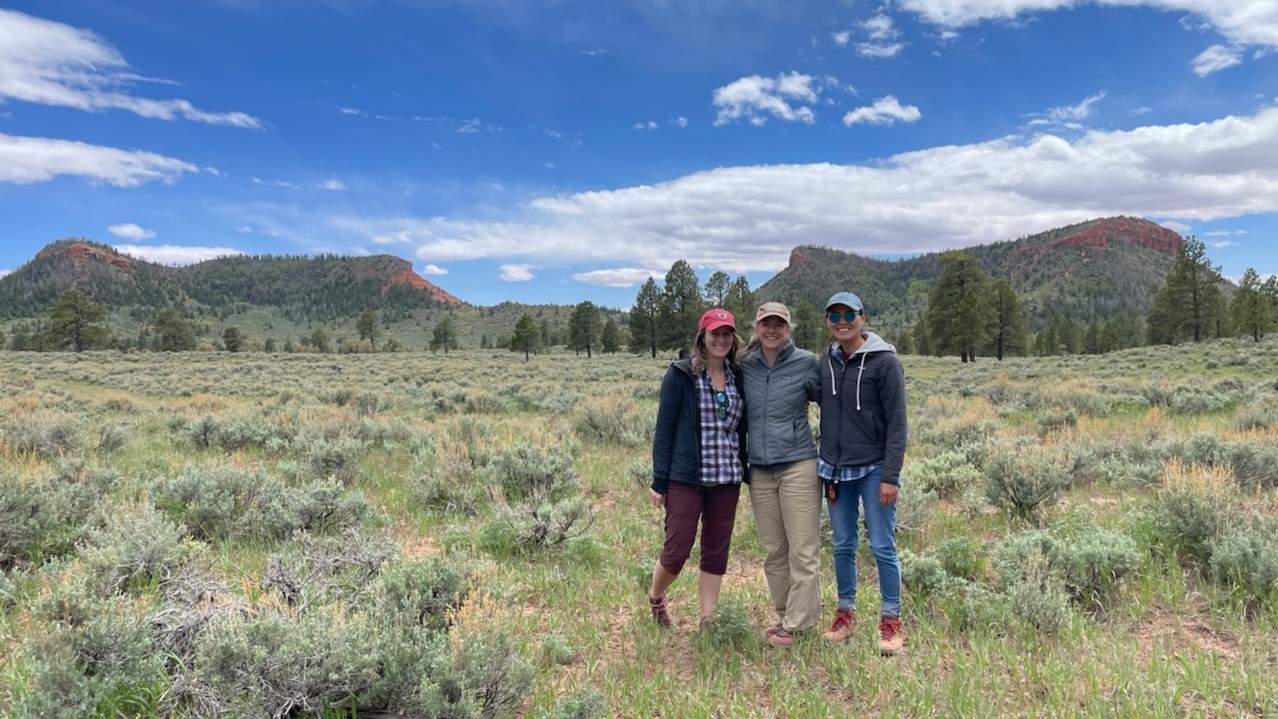
RPL fellows Cynthia Wilson and Teresa Cavazos Cohn and Associte Director of RLPI Susie Hayward in Bears Ears National Monument. Photo courtesy of Susie Hayward.
While at RPL, I’ve learned that the most vibrant interdisciplinary spaces may be unexpected and, by nature, emergent. I often wondered at the shape of the other fellows’ questions, the language they used, the way they engaged with their challenges. That process changed me as I put that creative energy into practice.
For example, I challenged myself to facilitate a space with my students that valued creative conversation over scripted content, supporting processes that allow the unexpected rather than the expected to emerge. In my course section, we used mapping as a tool and, as cartographers, questioned our suppositions about the shape of environmental justice—examining both the lines we draw and the lines that draw us. We asked epistemological and ethical questions about our own maps and each other’s maps, which I took to my students at the University of New Hampshire. I then brought their questions back to RPL and had them meet each other in the Harvard Map Room to examine maps and justice together. This experience gave rise to one of the questions that is now driving my work: “How will we draw lines more justly than the lines of the past as our global climate changes? And what happens when the arts, sciences, and humanities together with communities take on that task?”
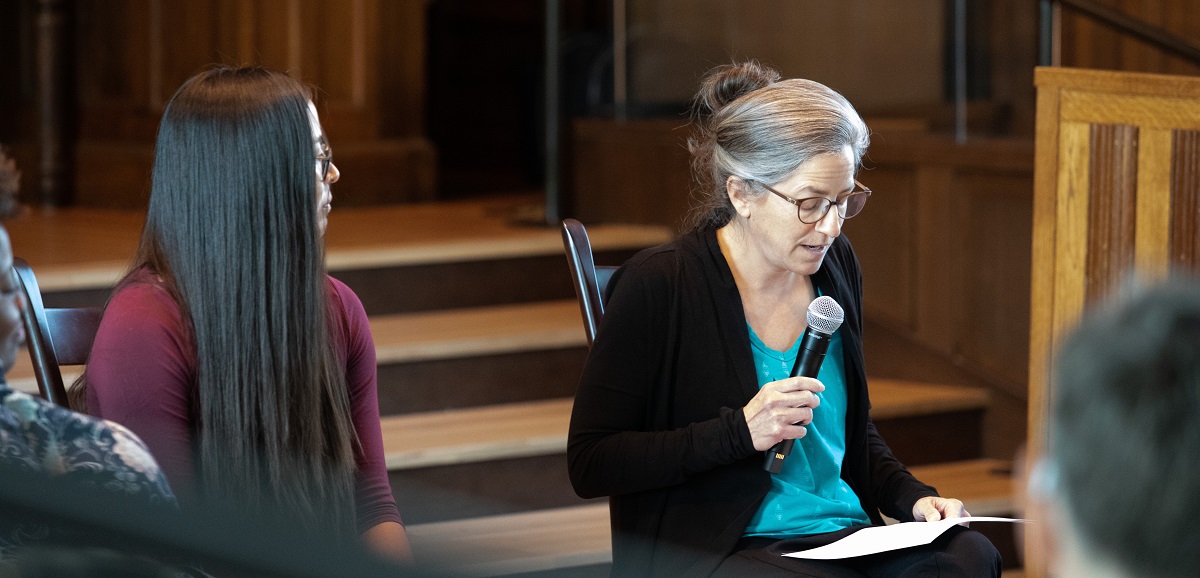
RPL taught me to foster creativity for its own sake and not to aim for a particular prescribed end, and that building creative capacity in community is an essential skill to refine as we engage with the critical issues of our time. One of the highlights of my fellowship was seeing the impact of creativity in community during the student-led Climate Justice Week in April 2023. The week was buoyant even amidst our grief in the social-ecological realities of climate change. I felt honored to speak on the Religious Literacy and Climate Justice panel with Naomi Washington-Leaphart and Cynthia Wilson and engage in shared questions together to find common themes in climate justice across the Earth sciences, Indigenous organizing, and governance. The spontaneity and the creative energy generated by interdisciplinary collision and collusion was a great and unexpected gift.
My most valuable moments as an RPL fellow were refreshingly unexpected and unplanned, including the invitation to become a fellow in the first place. One moment of this sort that I treasure occurred while visiting Cynthia Wilson, the RPL Native and Indigenous Rights Fellow, and members of her community at Bears Ears National Monument. On a windy night, I helped Cynthia and her mother move the Four Corners potatoes they had carefully propagated from their outdoor location to inside the hogan. These potatoes, Cynthia told us, are found near Diné and Puebloan homesites and, despite not being harvested very often anymore, are drought tolerant, highly nutritious, and may hold promise for drier climate futures. Protected from the wind inside Cynthia’s beautiful hogan, Susie Hayward and I slept on the ground next to those ancient, precious potatoes.
This experience felt reflective of our work at RPL to make conscious ethical choices about what to steward and how to tend most gracefully to a just peace. This is also the message I would like to leave with my students. Like the Four Corners potatoes, trust your questions and deep agitations, build relationships with them, and tend them over time. If your questions don’t fit the room, it may be time to transform the room, not your questions. Your questions hold promise for all our futures.
by Teresa Cavazos Cohn, RPL Climate Justice Fellow
Teresa Cavazos Cohn, PhD, is Associate Professor of Natural Resources and the Environment in the College of Life Sciences and Agriculture at the University of New Hampshire. While a research associate professor in the Department of Natural Resources and Society at the University of Idaho, Cohn co-founded the interdisciplinary Confluence Lab. Cohn’s research and outreach projects have been supported by the National Science Foundation, Andrew J. Mellon Foundation, NASA, and Milkweed Press.